


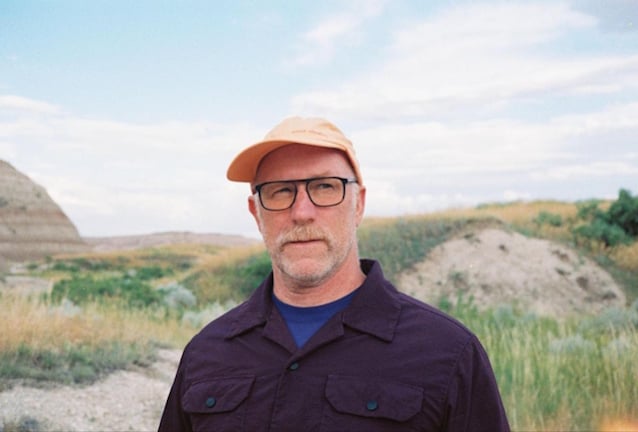
FAITH NO MORE Keyboardist And Gay Icon RODDY BOTTUM Speaks His Truth In New Memoir: 'I Want People To Be Provoked'
November 4, 2025By David E. Gehlke
As FAITH NO MORE climbed the charts in 1989 behind their "Epic" and "Falling To Pieces" singles, and then landed the coveted opening spot on GUNS N' ROSES and METALLICA's 1992 summer stadium tour, keyboardist Roddy Bottum was simply unable to enjoy any of it. A debilitating drug problem and struggles in coming out as a gay man led Bottum down some very dark paths that, within the burning cauldron of FAITH NO MORE and the tough, macho world of hard rock and heavy metal, made his journey even more foreboding. However, with the help of his family and friends, Bottum eventually got clean and came out of the closet, just in time to launch his acclaimed IMPERIAL TEEN indie pop outfit that carried him through FAITH NO MORE's extended period of inactivity.
Bottum's new "The Royal We" autobiography is achingly honest and forthcoming, sparing little detail from his troubled youth in San Francisco through FAITH NO MORE's roughshod early days when no one quite knew what to make of them. It's a fascinating, highly recommended page-turner that displays Bottum's depth as a writer and also someone with little to hide. Indeed, there are stories within "The Royal We" that may shock and/or surprise the average reader, but, as Bottum would tell BLABBERMOUTH.NET, that was the point all along.
Blabbermouth: "The Royal We" focuses on your teenage and early adult years. What made you choose that specific era for the book?
Roddy: "I kind of started writing a book with the idea that I was going to write about my entire life. I've always considered myself a writer; I just never wrote before. I write lyrics and I play with words all the time, but I've never sat down and dug into a really deep process of establishing a narrative. I started writing a story of my life, then I got specific. I think the political implications of where we are as a world today pointed me in the direction of provocation, if you will. I just feel we're in such a time, right now, in which people from the right, MAGA people, Trump people, people all over the world, Brexit people in London, who are speaking really loudly and are unabashedly spewing their vitriol. I felt a need to address that in my writing and kind of touché in terms of, 'You're going to talk your truth and what you think is the truth for the world? I'm going to come back at you and talk about my world.' When I was young, that was having sex in the bushes with men. I was shooting drugs in toilet stalls. On and on, the things I outlined in the book are provocative and stir a lot of shit. That was my intention, honestly.
"I have a weird relationship with Blabbermouth. It was COVID times. My mother was sick. It was a very dark place in America. My boyfriend and I were newly in love, and we started our band, MAN ON MAN, and we created a video in which we were together in our underwear, dancing around. It's an awesome song called 'Daddy'. In and of itself, it's an amazing pop song. We created a video based on it. Two bigger, hairy men in our underwear. We put it out in the world. I never received as much hate, homophobia, ageism, sizeism, and general just shit as I did from the readers of the posts and the people who saw that sort of video. That was super-shocking to me. They called us monsters. They called us ugly; they called us fat. They called us the f-word. It was really disturbing, especially for my boyfriend, who hadn't been in that before. What do you do with that? It set us back. It set a tone for where we were going with our project in a way that surprised me.
"The big part of why I focused on this part of my life to share, why I wanted to provoke people, is for situations like that. Initially, when this interview came up, 'Do you want to speak with David about your book?' I was like, 'Wait. From where?' 'Blabbermouth.' I was like, 'Fuck no.' Then, I was like, 'No. This is exactly where I'm coming from. I want people to read this, be provoked, and open their minds to my truth and reality.' Unapologetically, that's where I've gone with my writing, and I feel really strongly about it."
Blabbermouth: You write a lot about how destructive you were as a teenager. How does some of that feel to you now that you've written about it?
Roddy: "Clearly, there were things that I did that were outrageous, even through FAITH NO MORE. The things I did now surprise me, but I'm really proud of those odd things. That's another reason why I wrote my book. I find myself constantly telling stories of what I did as a kid and the outrageous things we did that were so dangerous and so borderline psychotic. The stories that I told were so rich. At some point, I said, 'I have to write this stuff down.' Looking back on it, especially on this sort of chapter of my life, when I'm sharing the book and these stories, I have no room for being ashamed or feeling bad about what I've done. I only have pride in the outrageous chapters of my life."
Blabbermouth: With a story like yours, usually the protagonist has deep issues with their parents. Outside of the episode where your dad was able to get into your desk despite the fact that you created a special keyhole that only you were supposed to be able to get into, your relationship with your parents seemed pretty stable.
Roddy: "It's totally true. I had a great relationship with my parents. I had an awesome relationship with my sisters. At the same time, I was dealing with the notion of coming out of the closet and my queerness in a city like San Francisco. It's like, 'What's the issue?' There couldn't have been a safer place to speak my truth. It didn't make sense that it would be hard for me. I struggled with that. Where was I as a kid? My parents supported me. My sisters were on my side. I was in San Francisco—the queerest, most open-minded, progressive city in the world. Why did I have a problem with coming out of the closet? That's what the book is about. It's about keeping these secrets and where they come from. Why do people keep secrets like this? What was my deal? What was my damage? The damage was my past and growing up, not necessarily with my parents or my family, but there were no queer role models for me as a kid."
Blabbermouth: You did an interview in the 1990s with The Advocate where you referenced Sir Elton John, but noted he wasn't a direct role model. I thought that was an interesting thing to say, being that he was one of the first to come out.
Roddy: "Not only Sir Elton, who, at the time, I was a big fan of. I heard him on the radio as a kid, and I thought he was gay. Then I heard him talking about his wife, and he had sort of sidestepped it. Even Freddie Mercury [QUEEN], who is the queerest, most flamboyant gay man you can imagine in a rock environment, wasn't out and open. Even THE VILLAGE PEOPLE with 'YMCA'. I remember them talking about themselves, kind of hedging it a little bit, not admitting they were gay. Then it went further into the now-realm. Michael Stipe [R.E.M.], who, we all knew, was queer, but never said it. Bob Mould [HÜSKER DÜ], the same. People just didn't speak about it. The only person I knew who was queer like me and out about it at the same time I was able to deal with it in public was Patty [Schemel], my friend, who was the drummer from HOLE. Besides her, there really wasn't anyone. My point was that there was a lot of damage in my inner childhood in terms of having to feel ashamed about being gay. That really worked its way through my body."
Blabbermouth: Do you think that's why you gravitated toward people like (early FAITH NO MORE singer) Chuck (Mosley) and Courtney Love (HOLE)?
Roddy: "Yeah, that's a good point. Probably so. I wasn't dealing with my truth, so seeing people deal with their truths in ways I wasn't able to was attractive, but I'm also drawn to crazy people. I'm drawn to people who have loud voices, who are provocative. I'm drawn to people who push buttons and create new worlds. Courtney is definitely one of those people. Chuck, in his own subtle way, was definitely one of those people. The list goes on and on. That's been my community since I was a kid: People who pushed boundaries."
Blabbermouth: You mentioned you understood why Chuck had to be fired from FAITH NO MORE, yet you didn't want him to leave. Did you stay in touch with him before he passed?
Roddy: "I certainly did. We were best friends always. I think it was a crazy step on my part, but we got nominated for a Grammy after Mike Patton joined, and we had that successful record. I took Chuck as my date. [Laughs] It was so outrageous. That is a bratty, fucked up thing to do. Absolutely, that's what I was going to do. He moved in with a really good friend of mine. We were really tight until he passed away."
Blabbermouth: Along those lines, do you want to talk about what it was like being a keyboard player in a male-dominated style of music where there really wasn't a place for one?
Roddy: "I think when we started the band, it was anything but male-dominated rock. We were an art project, first and foremost. We had this crazy concept when FAITH NO MORE first played shows; we wrote different songs for every performance. We would have a different singer perform with us every time. We sort of had a theme based on these cyclical loops we would play over and over. We were anything but a rock band. I think we evolved into that by default. As a member of the core three that started the band, our sort of role in just making music in that world was that we were very provocative. We were very art-leaning. We were really pushing boundaries. It was a really comfortable place to be for me. It did morph into something later. Jim Martin, the guitarist, joined us in the more successful days; he was the rock dude. He was from Hayward, California, but he played a flying-V guitar, and he was friends with METALLICA. All of a sudden, that association really catapulted us into this different world. Like James Hetfield wore a FAITH NO MORE shirt on the back of a record [1987's 'The $5.98 E.P. – Garage Days Re-Revisited'], it kind of changed everything. All of a sudden, we got the attention from these metal and rock kids. At that point, for me, as a queer kid playing pretty keyboards over a big cacophony of a rock sound, it was a lot. It was like, 'Wait? Who are these people?' At the same time, I was super open-minded. I was happy to have anyone listen to us."
Blabbermouth: Was it a challenge trying to establish an identity as a keyboardist in this kind of music?
Roddy: "Yeah. It was an interesting place to be, playing the keyboard in the loud rock spectrum. There weren't many keyboardists. In the '80s and '90s, you had YES or DEPECHE MODE. Even in the rock realm, there weren't keyboards. It wasn't a thing. It was ugly to look at, or it was for me. To think of the keyboards onstage, you can't move around. You're stuck behind this thing. I wanted to establish myself by throwing myself into ridiculous things just to make it interesting. I definitely had to adapt, evolve, and sort of change the role of the keyboard player in the world of rock music. It didn't exist at the time."
Blabbermouth: You talk in the book about how FAITH NO MORE was like a "sibling rivalry" and included the time when you ran into a guy from RADIOHEAD in the bathroom who said that everyone in his band got along. Do you think that inter-band conflict helped or hurt you?
Roddy: "It's a funny concept, isn't it? We were so bratty with each other. We were full of angst and argumentative amongst ourselves. I think, in a weird way, we had been touring in America for so long, living among each other, 24 hours a day, touring, touring, touring forever, with no success. We were doing what we did, but it was part of our makeup. We would argue and fight — physically — all the time. I think by the time we sort of landed in England for the first couple of times and people came to see us and interview us and talk to us, we didn't hide that fact. I remember clocking it at the time. We were so over-the-top outrageous in our fighting and dysfunction that it worked for us."
Blabbermouth: You wrote about how your drug addiction got worse as FAITH NO MORE became more popular. Were you able to enjoy any of it? Or was it all clouded by your addiction?
Roddy: "I was the keyboard player, this gay presence in this big rock presentation, this hetero presentation, I see it now. It's like, 'That was difficult for me.' Acting out in a way, also coupled with the fact that I was gay and not being open about it in that world, I think part of me dealing with that was seeking self-medication through drugs. I see now how it happens. It was funny. I wrote the book and recognized it as I was writing, 'Oh. That's the trajectory of my life. I was trying to fix things by drugging things.' Or, quelling these loud voices in my head. It felt like when I was writing: That's the narrative, that's where it goes. There's damage, trying to fix it and how it eventually gets fixed."
Blabbermouth: How much of your environment, whether on the road or at home with your boyfriend, played a part in all of that?
Roddy: "I think when I was in my 30s doing heroin, it felt like it became a thing. I remember clocking other musicians in bands. I remember Kurt [Cobain, NIRVANA] dealing with his addiction as he was touring. It's a specific sort of journey to find drugs from city to city when you're traveling and you don't have time to sort of address your addiction in a normal way that you would if you were just sitting at home. Being on the road, you're going from city to city, so you don't have your dealer who can supply you every day. [Laughs] You have to make do by going to the local train station or Greyhound station and find people who are fucked up and get drugs through them. That made it a challenge."
Blabbermouth: You bring up Kurt, and you were on the ground in Seattle, right after he passed away. How vivid are some of those memories still?
Roddy: "They are still specific to me. It's a chapter in my life that is so vivid, like I'll always remember. One is 'The Poseidon Adventure', the movie, I can recite it from beginning to end. The chapter on when Kurt passed away is so specific to me. It was a really charged, bizarre time. I remember being up there. We were all at their house after Kurt had passed. There was a core group of about 10 of us in the house with Courtney, who was going through what she was going through. There was a security team and the police, and we couldn't leave without being escorted. I remember the crazy things, but one of the security guys was like, 'Hey, watch what you say when you're outside. Even in the yard. Reporters are throwing microphones over the hedge, hoping to pick up on some conversation that you guys might be having about Kurt, Courtney or the family.' That just stuck with me."
Blabbermouth: Slash from GUNS N' ROSES sort of admonished you guys during the 1992 stadium tour for talking negatively about them. Do you regret any of that or the tour?
Roddy: "When we got offered that tour, we were really excited about it. Imagine being offered that tour. It was the biggest tour ever. In that same breath, it was a specific chapter in GUNS N' ROSES's career, when they put out that song that had the n-word and f-word, both in the same song ['One In A Million']. It was a time when they were under scrutiny. Looking back, bringing a band like us on the road helped their credibility in some ways. We didn't move any numbers, that's for sure. I remember there was a spectrum, you could see how many records you would sell after a show in a certain city, say, Cincinnati. We were watching that, like, 'We're on this tour! It's going to be so great.' 'Angel Dust' had come out. Then we were seeing the numbers that no one cared about it at all. [Laughs] No one bought our record. We sold records on who we were to the initial and core group, but the GUNS N' ROSES people were annoyed by us. The shows we played, I remember being booed and confused. It never made any sense, but god bless the people for inviting us. I'm appreciative. I don't want to come across as not, but I was and still am, happy to be involved in all of that."
Photo credit: Joey Holman


 Prev
Prev 